

Technology and innovation
As the leading Nordic P&C insurance group, and a major operator in the growing digital P&C insurance market in the UK, Sampo must constantly stay innovative to meet the evolving customer needs and technology.
By investing early and consistently in digitalisation, prioritising people, capabilities and long-term value, we have been able to build our highly skilled tech organisation that combines the strengths of both IT and business professionals, thus we are well-equipped to maintain our strong digital position.
For us, investing in digitality means making things simple and seamless in the digital environment across all parts of our organisation. From product development to sales, customer service and claims handling, we focus on digital solutions that improve the customer experience while also enhancing efficiency in our operations.
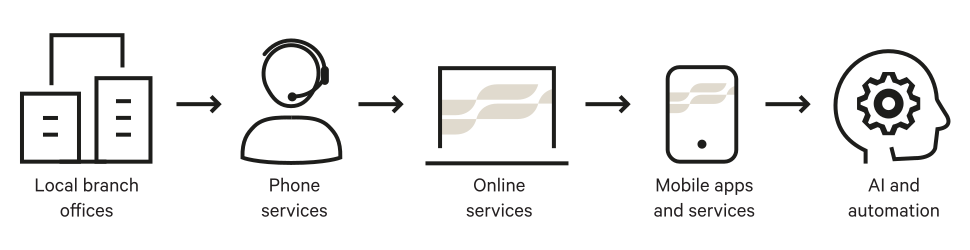
Over the years, we have continuously evolved our operating model—from local branch offices to phone‑based services, and later to a digital‑first and mobile‑first approach. Today, new opportunities enabled by AI are accelerating this journey even further.
Innovation in everyday work
Our approach to innovation is built into the way we work every day. Through structured processes and the strategic use of digitalisation, our customer brands continuously turn innovation into solutions that benefit both customers and employees.
Digitalisation across the value chain
Within the Sampo Group, we have been able to build what we call a digital customer engine. This digital customer engine is one of the key sources of our high customer satisfaction level as well as our topline growth and efficiency. The customers prefer to interact through digital channels, and thus the customer journey has been designed to meet those needs and preferences.
The first step of the digital customer journey is having the products and services available online, making it possible for the customers to calculate their price and make the purchase. This also includes being present at the price comparison websites in the UK, which is an important channel for our UK-based customer brand, Hastings.
Our self-service solutions are designed with both digital‑first and mobile‑first experiences in mind. This enables customers to update details such as payment information or address changes easily, without having to contact the company.
Self-service solutions also include assistance through apps in which the customers can have remote consultations via an app. An example is the If Pet Help App, a digital veterinary service that gives pet owners quick and easy access to professional advice directly through an app. Staffed by veterinarians, the service enables customers to consult a veterinarian via chat or video call, receive guidance on home treatment, and access emergency support when needed.
The digital customer journey also enables customers to report claims online, allowing most cases to be handled entirely digitally at a time and place convenient to the customer and without the need to call the company.
Finally, through our customer brands, Sampo Group has advanced digital processes and integrations in place in customer-facing solutions in collaboration with various valuable partnerships.
The digital customer journey is only successful when supported by highly skilled employees that provide superior customer service, e.g. in complex cases, when the customer prefers personal service, or a chatbot question is escalated to the human advisory centre. The employees are still the heart of the best-in-class customer service and the high customer satisfaction level.
Data analytics and machine learning
Data analytics is the process of analysing data to gain insights. In the insurance sector, data analytics is used for e.g. improving efficiency and quality in underwriting, claims handling, and fraud detection. With machine learning, the system learns from data and can develop models and algorithms. Data analytics and machine learning can e.g. be used for predictive modelling to forecast future events and outcomes and thus potential risks.
By applying data analytics and machine learning to our collection of historical data, we can predict certain events and outcomes. These insights can be used to prevent or mitigate certain damages and risks by informing customers to take preventive measures e.g. before storms and cloudbursts.
Automated claims handling
By leveraging digital technologies, such as automation, AI, data analytics, and machine learning, it has been possible to automate parts of the claims handling process. As step one, the customers can report the claim online and by using digital touch points, the customers are guided efficiently through the claims reporting process.
The simple claims are routed to straight-through processing, which means that the case can be handled entirely automated from reported claim to payment. More complex cases are handled by professional and skilled claims handlers. The automated process frees up time for our employees to provide customer service and focus on the complex cases, and the straight-through processing of simple cases ensures quick payment to the customers and thus increased customer satisfaction.
As part of the claims handling process, digital tools can also be used for photo inspection for some claims instead of physical inspections.
Telematics
Telematics insurance, also known as black box insurance, uses technology to monitor the policyholder's driving performance. The driving behaviour is tracked and can impact the insurance premiums. The better the driving performance, the better the premiums will be. Telematics can be used to track e.g.:
- speed
- acceleration
- braking
- cornering
- the use of the mobile phone while driving.
Telematics insurance offers an incentive to drive more safely, as the customers could be rewarded with reductions on their insurance premiums, and ultimately this could help improve road safety. At the moment, telematics insurance is only available in Sampo Group’s UK motor business via our customer brand Hastings.
Autonomous vehicles
The rapid development of advanced car technology is another area of interest for Sampo Group. Advanced car technology includes self-driving cars, also called autonomous vehicles (AVs), and it is a part of a continuous trend of increasing car safety. AVs use sensors, cameras, AI, and software to navigate and drive with little or no human interaction with the aim of improving both safety and convenience.
With the adoption of AVs, we may see a decrease in the frequency of collisions and some other claims. However, as repairs become more complex and expensive due to advanced technology, claims severity is expected to increase. Technology-intensive AVs also need to be properly repaired throughout their lifecycle, supporting continued demand for comprehensive motor insurance. In the Nordics, Sampo Group has a market-leading network with OEMs, thus providing us with valuable insights into this new technology and preparing us for the future.
Artificial intelligence
At Sampo Group, various types of artificial intelligence (AI) are used across the business, for example in fraud detection, claims handling, and chatbot-assisted customer service. AI supports day-to-day operations, allowing employees to focus on activities that create the greatest value. It also enhances decision-making by transferring complex data into clear, actionable insights. By supporting more personalised and responsive services, AI also strengthens Sampo’s customer relationships.
One example is IfGPT, a generative AI chatbot for If’s private customers in Denmark, Norway, and Sweden. It answers general insurance questions and provides personalised responses to logged-in users. IfGPT enables instant, 24/7 support and helps meet the growing demand for digital services, while allowing employees to focus on more complex customer needs and deliver high-quality personal service.
Ethical use of AI
Sampo recognises that the use of AI consumes energy and has an environmental impact. Therefore, the Group is assessing this area as part of its broader ambition to reduce the environmental footprint of its operations and to reinforce sustainability expectations across its value chain. For example, Sampo uses renewable electricity for its data centre operations and selects data centre providers based on their commitment to minimising environmental impact, including through efficient cooling and energy management. In addition, energy efficiency is prioritised when procuring and operating IT infrastructure, ensuring that resources are used as effectively as possible.
Sampo is committed to the ethical and responsible use of AI, including ensuring transparency, fairness, and appropriate human oversight, supported by strong governance. All AI use must comply with applicable laws and regulations as well as Group principles and company-specific policies, instructions, and guidelines. The Sampo Group Code of Conduct serves as the group-level guidance document, and it is reviewed annually and approved by the Board of Directors. Privacy and data protection are also central considerations.
To promote responsible use, employees are trained on available tools, how to use them in practice, AI ethics, and the associated risks and opportunities. Internal working groups, forums, and clearly defined roles further strengthen oversight and accountability. As technologies and regulatory expectations evolve, Sampo continuously develops its practices to ensure AI is used in a safe, secure, and trustworthy manner. The Group actively engages with industry associations, regulators, and academia to both contribute to and learn from developments in responsible AI.
Prevention – from reactive to proactive
The insurance sector is not only evolving digitally, but also from a reactive approach to being proactive and focusing on preventive measures. The preventive measures can be physical devices such as leak detectors that can detect leaking water pipes in houses. More homeowners are asking for guidance on how to prevent damage from extreme weather and how to prepare for the unexpected that might occur in your home, so it can also be home checks and digital guides to discuss preventive measures and recommendations with homeowners as part of their home insurance. Being proactive is also contacting the most exposed customers before a storm to advise them on how to best safeguard their homes and property.
Preventive measures are also part of digitalisation in the insurance sector as data analytics and machine learning applied to historical data can predict certain events and outcomes, and these insights can be used to prevent or mitigate certain damages and risks.
Sampo Group and its customer brands as well as the insurance sector as a whole have already come a long way in applying digital tools to both customer-facing and internal processes. We have developed new pathways for growth while optimising and simplifying the customer journey by focusing on customer centric capabilities and digital experiences. At its core, our commitment to innovation is our commitment to creating customer value, and thus shareholder value.
Updated